

INTRODUCTION
There is limited evidence regarding the use, adherence, and safety of medication, vaccination, and alternative medicine such as vitamins and supplements, herbs, homeopathy, and acupuncture during pregnancy and breastfeeding. The potential risks and ethical considerations of pregnancy and lactation in research1,2, along with androcentrism, have resulted in a lack of studies related to women’s health processes3.
The use of medication for various symptoms and chronic and acute conditions during pregnancy is common and, in some cases, necessary to prevent the worsening of pre-existing diseases and to minimize negative effects during pregnancy, childbirth, and on fetal health4. Although many women choose to take medication during pregnancy and lactation, decision-making can be complex due to the limited evidence on the safety of certain drugs5. At the same time, from a gender perspective, it is important to acknowledge the effects of medicalization processes on women’s health – particularly during pregnancy, childbirth, and breastfeeding6 – and how these may influence women’s perceptions of such products during these stages.
Regarding vaccination, certain vaccines have been shown to be safe and are recommended at specific times during pregnancy (e.g. MMR, influenza, pertussis, and COVID-19)7. Some of the vaccines that are considered safe and recommended still show low coverage rates during pregnancy, as uncertainties and doubts often arise when deciding whether to get vaccinated8,9. For this reason, shared decision-making with healthcare professionals (HCPs) is crucial to improve use and adherence, as well as to ensure informed decisions regarding these products – an approach that has been shown to enhance the overall experience of pregnancy10.
Women are the main users of complementary and alternative medicine, which is also commonly used during pregnancy and breastfeeding. Due to concerns about the possible teratogenic effects of many conventional medications, some women may choose what they perceive as more ‘natural’ alternatives11. Nevertheless, there may also be hesitation about using herbal products during pregnancy or lactation due to fears about potential effects12. Therefore, it is essential to understand the use of such products during these stages.
It is also important to identify the sources of information women rely on (e.g. the internet, pre- and postnatal groups, healthcare professionals, etc.) to inform themselves about pregnancy, childbirth, and breastfeeding in relation to these three categories of products, and to address the concerns they may have regarding their child’s well-being13. At the same time, from a gender perspective, it is necessary again to consider the effects of the medicalization and technologization of pregnancy, childbirth, and breastfeeding, to move beyond the dichotomy between the desire for the child’s well-being and women’s self-determination over their own bodies14-16. However, there is a lack of evidence regarding medication use during pregnancy and lactation, and the potential positive and negative effects it may have on pregnant women and their offspring. This situation directly impacts HCP clinical practice, given the challenges encountered when prescribing during these periods17, and taking into account that women rely principally on HCP advice when taking medication.
Therefore, the aim of this study is to identify the perceptions and needs related to the use of medication, vaccination, and alternative medicine during pregnancy and breastfeeding in Catalonia. Additionally, it seeks to understand where pregnant and breastfeeding women turn to and how they seek information when they have doubts regarding the use of medication, vaccination, and alternative medicine.
METHODS
Design
This is a descriptive cross-sectional study using data from a survey on opinions and feelings about the use of medicines during pregnancy and postpartum, including breastfeeding, with a gender perspective.
Populations and recruitment
We non-randomly recruited 903 pregnant and recently postpartum women who attended the Sexual and Reproductive Health Care Services (Atenció a la Salut Sexual i Reproductiva, ASSIR) of Catalan Primary Care between November 2024 and June 2025. Inclusion criteria for participating in the survey were being aged 15–49 years, being pregnant or recently postpartum, and receiving pregnancy follow-up care at ASSIR. The inclusion criterion for this study was having available information on the gestational stage. We excluded 14 women who did not have information on the gestational stage. The final sample included 889 pregnant women who had recently given birth from the Catalan Primary Care Service.
Instrument
The instrument used was an ad hoc questionnaire developed following the thematic framework identified in an earlier qualitative study conducted as part of the same research project, which is not yet published18. The questionnaire was developed for this study and evaluated by a panel of experts to ensure content validity and clarity, and a pilot test was conducted (Supplementary file). Nevertheless, a formal reliability assessment was not performed. It included 21 closed-ended questions, 4 closed-ended questions with an open ‘other’ option, 2 multiple-choice items with an open ‘other’ option, and 1 open-ended question addressing the use of medicines during pregnancy and breastfeeding, alternative medicine during pregnancy, and vaccination during pregnancy and breastfeeding. In addition, it collected sociodemographic characteristics, general health information, and pregnancy-related data. The questionnaire was available in Catalan and Spanish and was administered through the REDCap (Research Electronic Data Capture) platform by the participants themselves or via direct interview by the ASSIR nursing team. Study data were collected and managed using REDCap tools, hosted at Fundació Institut Universitari per a la recerca a l’Atenció Primària de Salut Jordi Gol i Gurina (IDIAPJGol)19,20. REDCap is a secure, web-based software platform designed to support data capture for research studies, providing: 1) an intuitive interface for validated data capture; 2) audit trails for tracking data manipulation and export procedures; 3) automated export procedures for seamless data downloads to common statistical packages; and 4) procedures for data integration and interoperability with external sources.
Opinions and feelings about the use of medications during pregnancy
The study collected data on women’s opinions and feelings about the use of medicines during pregnancy through four questions addressing: how decisions to take medicines were made (doctor prescription or recommendation, advice from family or friends, or self-decision); sources consulted for information on medication risks (health professionals, the internet, medicine leaflets, advice from family or friends, or no consultation); whether conflicts arose between healthcare advice and personal research; and feelings about taking medicines during pregnancy (safe and confident, concerned but necessary, uncomfortable but necessary, uncomfortable and considered unnecessary, or not taking medicines).
Opinions and feelings of complementary treatments during pregnancy
Data on opinions and experiences with alternative medicine and treatments during pregnancy were gathered through questions on whether vitamin supplements were used (doctor-prescribed, self-chosen, or not used) and on overall experiences with alternative medicine and treatments, ranging from very positive to very negative, including an option for non-use.
Opinions and feelings about vaccination during pregnancy
Data on opinions and attitudes toward vaccination during pregnancy were collected using questions on the perceived need for pre-pregnancy vaccination consultations, agreement with vaccination during pregnancy, and willingness to receive specific types of vaccines, including those protecting the mother, the baby, both, or none.
Opinions and feelings about medication use during breastfeeding
Data on opinions and practices regarding medication use during breastfeeding were collected through questions addressing: patterns of medication use for acute and chronic conditions; decision-making about taking medicines; sources consulted for information on medication risks; and whether conflicts were experienced between healthcare professional recommendations and personal research.
Data on general health status, pregnancy, breastfeeding, and medication use during pregnancy
General health was self-rated on a six-point scale from excellent to very bad. Pregnancy-related data included the gestational window and the type of healthcare service providing prenatal care. Breastfeeding data captured whether women had breastfed or intended to do so. Medication use during pregnancy was assessed by identifying health conditions or symptoms requiring treatment, with predefined symptom categories and additional conditions derived from open-ended responses. Finally, the use of alternative medicine and therapies during pregnancy was recorded through yes/no questions covering various therapies, with further categories identified from open responses.
Sociodemographic data
Sociodemographic data included age group, employment status, family structure, education level, and city population size. Age was categorized in five-year intervals and subsequently recoded as 15–24, 25–39, and 40–49 years for the present analysis. Employment status, family structure, and education level were collected with multiple response options and subsequently recoded into broader categories for analysis. City population size was classified as <10000 or ≥10000 inhabitants, while the ASSIR Center attended was recorded but not used in the analysis (Table 1).
Table 1
Sociodemographic, health, and pregnancy
Sample size
Sample size calculation was not performed because this was a descriptive study. Since the objective was to characterize the population rather than to test hypotheses or estimate associations, statistical power was not required. The study included all eligible participants recruited during the data collection period.
Statistical analysis
We present the sociodemographic, pregnancy-related, breastfeeding, general health, and medication use characteristics during pregnancy as absolute frequencies and percentages. We also describe opinions and feelings about medication use during pregnancy, alternative medicine and treatments during pregnancy, and vaccination during pregnancy, as well as medication use during breastfeeding, all by absolute frequency and percentage. We describe the variables overall and stratified by age group, education level, and gestational window. In addition, we explore differences between groups using the chi-squared test or Fisher’s exact test, depending on whether the assumptions were met.
RESULTS
A total of 903 pregnant and recently postpartum women were included in the study. Most participants were aged 30–34 years (40.2%), employed (79.4%), living with a partner (48.4%), and had a university education (63.7%). Over half (63.3%) lived in towns with <10000 inhabitants. Nearly half (48.9%) rated their general health as very good, 54.7% were in the second half of pregnancy, and 55.3% received pregnancy monitoring in the public healthcare service. The majority (89.9%) reported currently breastfeeding or intending to do so (Table 1).
Table 2 shows the health situation during pregnancy; a total of 59.3% of participants were diagnosed with a chronic illness, a health problem requiring closer monitoring, or minor symptoms that needed medication during pregnancy. In this sense, the most common symptoms and sensations requiring medication among pregnant women, affecting more than one in ten, were nausea and vomiting (30.3%), anemia (22.9%), heartburn (21.3%), headaches (20.2%), colds (15.1%), backache or low back pain (14.7%), constipation (11.5%), and urinary tract infections (11.5%). Women in the first half of pregnancy present more nausea (43.1%), in the second half of pregnancy, they present more anemia (25.9%), headache (23.9%), and insomnia (9.5%) (Figure 1 and Supplementary file Table 2). Table 2 shows that a total of 76.4% of participants have taken vitamin supplements prescribed by a physician. Table 2 also contains the information about the experience with alternative medicine, being more positive among the women with university studies (33.2%). Nonetheless, 66.6% of participants reported not using alternative medicine and therapies (Table 2). Osteopathy is the most used alternative medicine and therapy during pregnancy (12.4%), and participants with university studies were the ones who consumed the most alternative medicines (17.1%) (Figure 2 and Supplementary file Table 3).
Table 2
Health situation, vitamins use and experience of complementary therapies during pregnancy overall and stratified by age group, education level, and gestational stage
| All | Age group | Education level | Gestational window | |||||||||||||
|---|---|---|---|---|---|---|---|---|---|---|---|---|---|---|---|---|
| A1 | A2 | A3 | p | qa | E1 | E2 | E3 | E4 | p | qa | G1 | G2 | G3 | p | qa | |
| Total, n | ||||||||||||||||
| 889 | 34 | 772 | 83 | 20 | 83 | 215 | 566 | 72 | 486 | 331 | ||||||
| Which of these three situations best fits your situation? | ||||||||||||||||
| 0.155b | 0.466 | 0.968c | 0.968 | 0.259c | 0.461 | |||||||||||
| I had a chronic illness that required significant monitoring during pregnancy | ||||||||||||||||
| 253 (28.6) | 10 (29.4) | 227 (29.6) | 16 (19.3) | 4 (20.0) | 23 (27.7) | 66 (31.0) | 159 (28.2) | 22 (30.6) | 151 (31.2) | 80 (24.3) | ||||||
| I had a health problem that required medical visits during pregnancy | ||||||||||||||||
| 201 (22.7) | 9 (26.5) | 169 (22.0) | 23 (27.7) | 4 (20.0) | 18 (21.7) | 47 (22.1) | 131 (23.2) | 12 (16.7) | 106 (21.9) | 83 (25.2) | ||||||
| I had minor symptoms and took medication during pregnancy | ||||||||||||||||
| 69 (7.8) | 0 (0.0) | 59 (7.7) | 10 (12.0) | 1 (5.0) | 5 (6.0) | 18 (8.5) | 45 (8.0) | 8 (11.1) | 33 (6.8) | 28 (8.5) | ||||||
| I did not experience any of these things | ||||||||||||||||
| 362 (40.9) | 15 (44.1) | 313 (40.8) | 34 (41.0) | 11 (55.0) | 37 (44.6) | 82 (38.5) | 229 (40.6) | 30 (41.7) | 194 (40.1) | 138 (41.9) | ||||||
| Missing | ||||||||||||||||
| 4 | 0 | 4 | 0 | 0 | 0 | 2 | 2 | 0 | 2 | 2 | ||||||
| Have you taken vitamins supplements during pregnancy? | ||||||||||||||||
| 0.608b | 0.608 | 0.252b | 0.378 | 0.461b | 0.461 | |||||||||||
| Prescribed by doctor | ||||||||||||||||
| 679 (90.7) | 26 (86.7) | 581 (90.6) | 72 (92.3) | 18 (100.0) | 66 (85.7) | 169 (90.4) | 422 (91.3) | 52 (89.7) | 381 (91.8) | 246 (89.1) | ||||||
| Own choice | ||||||||||||||||
| 0 (0.0) | 0 (0.0) | 0 (0.0) | 0 (0.0) | 0 (0.0) | 0 (0.0) | 0 (0.0) | 0 (0.0) | 0 (0.0) | 0 (0.0) | 0 (0.0) | ||||||
| Not taken any | ||||||||||||||||
| 70 (9.3) | 4 (13.3) | 60 (9.4) | 6 (7.7) | 0 (0.0) | 11 (14.3) | 18 (9.6) | 40 (8.7) | 6 (10.3) | 34 (8.2) | 30 (10.9) | ||||||
| Missing | ||||||||||||||||
| 140 | 4 | 131 | 5 | 2 | 6 | 28 | 104 | 14 | 71 | 55 | ||||||
| How has your experience been in use complementary treatments during pregnancy? | ||||||||||||||||
| 0.581c | 0.608 | <0.001c | <0.001 | 0.325c | 0.461 | |||||||||||
| Very positive | ||||||||||||||||
| 107 (13.0) | 2 (6.5) | 95 (13.3) | 10 (13.2) | 2 (13.3) | 2 (2.5) | 19 (9.4) | 84 (16.2) | 8 (12.5) | 63 (13.9) | 36 (11.9) | ||||||
| Positive | ||||||||||||||||
| 118 (14.4) | 1 (3.2) | 106 (14.9) | 11 (14.5) | 2 (13.3) | 3 (3.8) | 24 (11.8) | 88 (17.0) | 5 (7.8) | 63 (13.9) | 50 (16.5) | ||||||
| Neutral | ||||||||||||||||
| 46 (5.6) | 2 (6.5) | 41 (5.8) | 3 (3.9) | 1 (6.7) | 2 (2.5) | 10 (4.9) | 32 (6.2) | 5 (7.8) | 25 (5.5) | 16 (5.3) | ||||||
| Negative/very negative | ||||||||||||||||
| 3 (0.4) | 0 (0.0) | 3 (0.4) | 0 (0.0) | 0 (0.0) | 0 (0.0) | 1 (0.5) | 2 (0.4) | 0 (0.0) | 0 (0.0) | 3 (1.0) | ||||||
| Did not use them | ||||||||||||||||
| 546 (66.6) | 26 (83.9) | 468 (65.6) | 52 (68.4) | 10 (66.7) | 72 (91.1) | 149 (73.4) | 313 (60.3) | 46 (71.9) | 302 (66.7) | 198 (65.3) | ||||||
| Missing | ||||||||||||||||
| 69 | 3 | 59 | 7 | 5 | 4 | 12 | 47 | 8 | 33 | 28 | ||||||
Figure 1
Percentages of health problems and symptoms during pregnancy stratified by education level, age group, and gestational stage
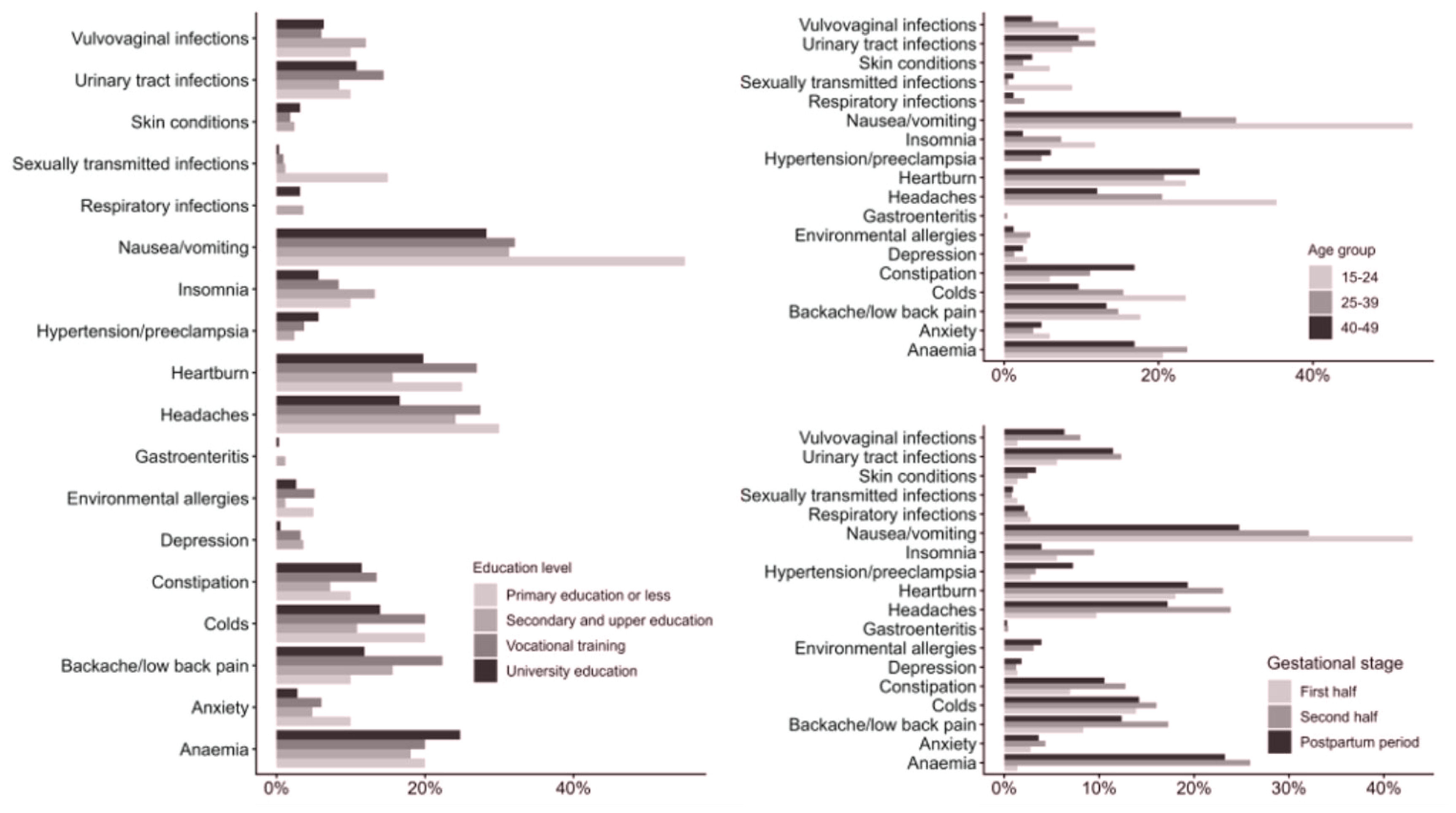
Figure 2
Percentages of use of alternative therapies stratified by education level, age group and gestational stage
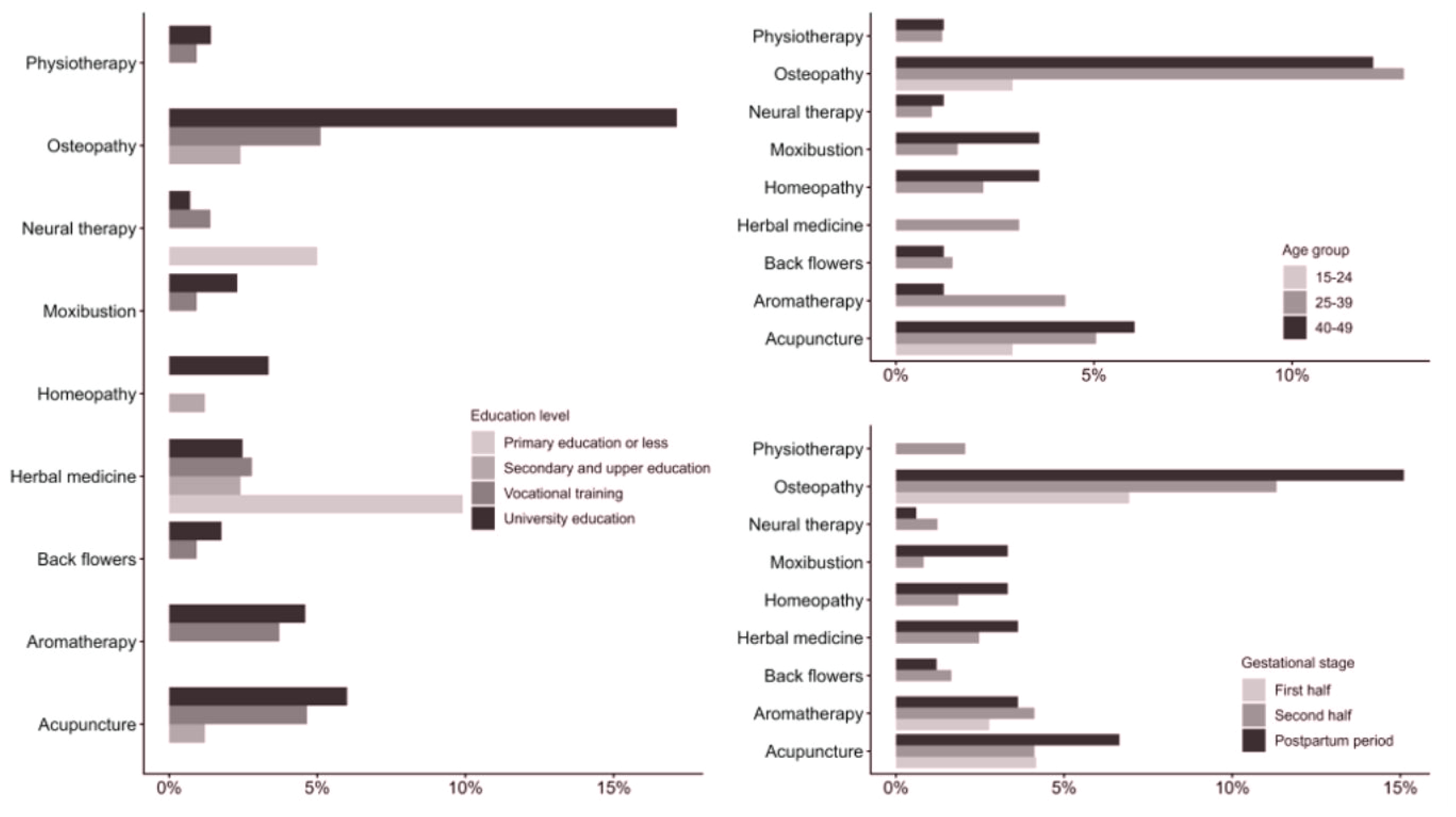
Table 3 presents the decision-making processes, information sources, and perceptions regarding the use of medicines during pregnancy. Overall, 84.6% of women reported that they decided to take medicines according to a prescription and/or recommendation from healthcare professionals. Additionally, 76.6% consulted healthcare professionals about the risks associated with medicine use during pregnancy, 72.0% reported no conflict between their own research and professional recommendations, and 51.7% felt safe and confident when taking medicines during pregnancy. The 40–49 years age group was the one that consulted more with HCPs regarding the medication they took (87.2%), and the younger group, aged 15–24 years, was the one that consulted more with the medicine leaflet (21.2%) (Table 3).
Table 3
Decision-making, information sources, and perceptions regarding the use of medicines during pregnancy overall and stratified by age group, education level and gestational stage
| All | Age group | Education level | Gestational window | |||||||||||||
|---|---|---|---|---|---|---|---|---|---|---|---|---|---|---|---|---|
| A1 | A2 | A3 | p | qa | E1 | E2 | E3 | E4 | p | qa | G1 | G2 | G3 | p | qa | |
| Total, n | ||||||||||||||||
| 889 | 34 | 772 | 83 | 20 | 83 | 215 | 566 | 72 | 486 | 331 | ||||||
| If you took a medicine during pregnancy how did you make the decision? | ||||||||||||||||
| 0.832b | 0.832 | 0.587b | 0.587 | 0.025b | 0.050 | |||||||||||
| Prescription and/or recommendation from healthcare professionals | ||||||||||||||||
| 752 (94.6) | 30 (93.8) | 652 (94.5) | 70 (95.9) | 17 (94.4) | 72 (93.5) | 194 (96.5) | 464 (93.9) | 54 (88.5) | 421 (95.9) | 277 (93.9) | ||||||
| Recommendation from pharmacists | ||||||||||||||||
| 17 (2.1) | 1 (3.1) | 14 (2.0) | 2 (2.7) | 0 (0.0) | 1 (1.3) | 2 (1.0) | 14 (2.8) | 1 (1.6) | 6 (1.4) | 10 (3.4) | ||||||
| Advice from family or friends | ||||||||||||||||
| 3 (0.4) | 0 (0.0) | 3 (0.4) | 0 (0.0) | 0 (0.0) | 0 (0.0) | 0 (0.0) | 3 (0.6) | 0 (0.0) | 1 (0.2) | 2 (0.7) | ||||||
| Own decision | ||||||||||||||||
| 23 (2.9) | 1 (3.1) | 21 (3.0) | 1 (1.4) | 1 (5.6) | 4 (5.2) | 5 (2.5) | 13 (2.6) | 6 (9.8) | 11 (2.5) | 6 (2.0) | ||||||
| Missing | ||||||||||||||||
| 94 | 2 | 82 | 10 | 2 | 6 | 14 | 72 | 11 | 47 | 36 | ||||||
| Where have you consulted about the risks of medicines? | ||||||||||||||||
| 0.002b | 0.006 | 0.108d | 0.216 | 0.084d | 0.084 | |||||||||||
| Health professionals | ||||||||||||||||
| 681 (80.3) | 23 (69.7) | 590 (80.1) | 68 (87.2) | 14 (77.8) | 65 (80.2) | 166 (79.0) | 433 (81.1) | 54 (79.4) | 386 (83.7) | 241 (75.5) | ||||||
| The Internet | ||||||||||||||||
| 69 (8.1) | 1 (3.0) | 62 (8.4) | 6 (7.7) | 0 (0.0) | 5 (6.2) | 16 (7.6) | 48 (9.0) | 5 (7.4) | 35 (7.6) | 29 (9.1) | ||||||
| The medicine leaflet | ||||||||||||||||
| 69 (8.1) | 7 (21.2) | 62 (8.4) | 0 (0.0) | 2 (11.1) | 5 (6.2) | 19 (9.0) | 41 (7.7) | 6 (8.8) | 25 (5.4) | 38 (11.9) | ||||||
| Advice from family or friends | ||||||||||||||||
| 4 (0.5) | 1 (3.0) | 2 (0.3) | 1 (1.3) | 1 (5.6) | 0 (0.0) | 1 (0.5) | 2 (0.4) | 0 (0.0) | 2 (0.4) | 2 (0.6) | ||||||
| I did not consult about the risks | ||||||||||||||||
| 25 (2.9) | 1 (3.0) | 21 (2.8) | 3 (3.8) | 1 (5.6) | 6 (7.4) | 8 (3.8) | 10 (1.9) | 3 (4.4) | 13 (2.8) | 9 (2.8) | ||||||
| Missing | ||||||||||||||||
| 41 | 1 | 35 | 5 | 2 | 2 | 5 | 32 | 4 | 25 | 12 | ||||||
| I’ve experienced any conflict between my healthcare professional recommended and what I’ve researched on my own about the use of medicines during pregnancy | ||||||||||||||||
| 226 (26.1) | 6 (19.4) | 194 (25.7) | 26 (32.1) | 0.317c | 0.423 | 3 (15.8) | 12 (14.8) | 49 (23.3) | 161 (29.2) | 0.017b | 0.069 | 18 (25.7) | 94 (19.9) | 114 (35.3) | <0.001c | <0.001 |
| Missing | ||||||||||||||||
| 23 | 3 | 18 | 2 | 1 | 2 | 5 | 15 | 2 | 13 | 8 | ||||||
| How did you feel about taking medicines during pregnancy? | ||||||||||||||||
| 0.109b | 0.218 | 0.565d | 0.587 | 0.054d | 0.071 | |||||||||||
| Save and confident | ||||||||||||||||
| 460 (55.5) | 21 (65.6) | 402 (55.8) | 37 (48.7) | 13 (72.2) | 50 (64.9) | 110 (53.1) | 284 (54.4) | 36 (53.7) | 264 (58.8) | 160 (51.1) | ||||||
| Concerned but it was necessary | ||||||||||||||||
| 218 (26.3) | 8 (25.0) | 189 (26.2) | 21 (27.6) | 5 (27.8) | 19 (24.7) | 60 (29.0) | 132 (25.3) | 16 (23.9) | 118 (26.3) | 84 (26.8) | ||||||
| Uncomfortable but it was necessary | ||||||||||||||||
| 106 (12.8) | 2 (6.3) | 96 (13.3) | 8 (10.5) | 0 (0.0) | 5 (6.5) | 25 (12.1) | 76 (14.6) | 7 (10.4) | 51 (11.4) | 48 (15.3) | ||||||
| Uncomfortable and I believe that it was unnecessary | ||||||||||||||||
| 11 (1.3) | 0 (0.0) | 7 (1.0) | 4 (5.3) | 0 (0.0) | 1 (1.3) | 3 (1.4) | 7 (1.3) | 1 (1.5) | 5 (1.1) | 5 (1.6) | ||||||
| Did not take | ||||||||||||||||
| 34 (4.1) | 1 (3.1) | 27 (3.7) | 6 (7.9) | 0 (0.0) | 2 (2.6) | 9 (4.3) | 23 (4.4) | 7 (10.4) | 11 (2.4) | 16 (5.1) | ||||||
| Missing | ||||||||||||||||
| 60 | 2 | 51 | 7 | 2 | 6 | 8 | 44 | 5 | 37 | 18 | ||||||
Table 4 presents attitudes and opinions regarding vaccination before and during pregnancy. Overall, 64.6% of participants considered it necessary to receive information from healthcare professionals about vaccination before becoming pregnant, 83.4% agreed with getting vaccinated during pregnancy, and 65.6% were willing to receive vaccines both to reduce the risk of disease during pregnancy and to prevent disease in the baby. During the first half of pregnancy, women present more reticence to get vaccinated (26.1%) (Table 4).
Table 4
Attitudes and opinions regarding vaccination before and during pregnancy overall and strataified by age group, eduation level and gestational stage
| All | Age group | Education level | Gestational window | |||||||||||||
|---|---|---|---|---|---|---|---|---|---|---|---|---|---|---|---|---|
| A1 | A2 | A3 | p | qa | E1 | E2 | E3 | E4 | p | qa | G1 | G2 | G3 | p | qa | |
| Total, n | ||||||||||||||||
| 889 | 34 | 772 | 83 | 20 | 83 | 215 | 566 | 72 | 486 | 331 | ||||||
| Do you consider it necessary to have a medical consultation before becoming pregnant to ensure that you have had all the necessary vaccinations? | ||||||||||||||||
| 0.427b | 0.641 | 0.478d | 0.478 | 0.646d | 0.646 | |||||||||||
| Yes | ||||||||||||||||
| 574 (65.2) | 27 (79.4) | 496 (64.8) | 51 (63.0) | 16 (84.2) | 55 (66.3) | 136 (64.5) | 364 (64.8) | 43 (60.6) | 310 (64.3) | 221 (67.6) | ||||||
| No | ||||||||||||||||
| 133 (15.1) | 2 (5.9) | 119 (15.6) | 12 (14.8) | 1 (5.3) | 11 (13.3) | 27 (12.8) | 93 (16.5) | 10 (14.1) | 76 (15.8) | 47 (14.4) | ||||||
| Don’t know | ||||||||||||||||
| 173 (19.7) | 5 (14.7) | 150 (19.6) | 18 (22.2) | 2 (10.5) | 17 (20.5) | 48 (22.7) | 105 (18.7) | 18 (25.4) | 96 (19.9) | 59 (18.0) | ||||||
| Missing | ||||||||||||||||
| 9 | 0 | 7 | 2 | 1 | 0 | 4 | 4 | 1 | 4 | 4 | ||||||
| I agree with getting vaccinated during pregnancy | ||||||||||||||||
| 741 (86.1) | 28 (87.5) | 645 (86.2) | 68 (84.0) | 0.824c | 0.824 | 18 (94.7) | 65 (82.3) | 176 (84.2) | 478 (87.1) | 0.392c | 0.478 | 51 (73.9) | 417 (88.3) | 273 (85.3) | 0.005b | 0.007 |
| Missing | ||||||||||||||||
| 28 | 2 | 24 | 2 | 1 | 4 | 6 | 17 | 3 | 14 | 11 | ||||||
| Which vaccinations would you be willing to have? | ||||||||||||||||
| 0.142c | 0.427 | <0.001d | <0.001 | <0.001d | <0.001 | |||||||||||
| Those necessary to reduce the risk of disease during pregnancy | ||||||||||||||||
| 90 (10.3) | 5 (15.2) | 78 (10.3) | 7 (8.4) | 3 (15.0) | 13 (15.9) | 36 (16.9) | 37 (6.7) | 16 (22.5) | 52 (10.9) | 22 (6.7) | ||||||
| Those that prevent disease in the baby | ||||||||||||||||
| 172 (19.6) | 5 (15.2) | 157 (20.7) | 10 (12.0) | 4 (20.0) | 16 (19.5) | 35 (16.4) | 115 (20.7) | 5 (7.0) | 92 (19.2) | 75 (23.0) | ||||||
| Both of the above | ||||||||||||||||
| 583 (66.6) | 20 (60.6) | 501 (65.9) | 62 (74.7) | 13 (65.0) | 45 (54.9) | 132 (62.0) | 391 (70.3) | 43 (60.6) | 318 (66.4) | 222 (68.1) | ||||||
| None | ||||||||||||||||
| 31 (3.5) | 3 (9.1) | 24 (3.2) | 4 (4.8) | 0 (0.0) | 8 (9.8) | 10 (4.7) | 13 (2.3) | 7 (9.9) | 17 (3.5) | 7 (2.1) | ||||||
| Missing | ||||||||||||||||
| 13 | 1 | 12 | 0 | 0 | 1 | 2 | 10 | 1 | 7 | 5 | ||||||
Table 5 shows the decision-making processes, information sources, and perceptions regarding the use of medicines during breastfeeding, with a 40.3% of participants who took medication, doing so according to the usual schedule or when it was due. Moreover, 48.8% used medicines only if necessary and prescribed by healthcare professionals. A total of 81.4% made decisions about medicine use based on prescriptions or healthcare recommendations. Additionally, 66.1% sought information on the risks of medication use during breastfeeding from healthcare professionals. Finally, 70.5% did not experience conflicts between the information they sought and the recommendations they received. Education level affected the way women related to their HCP when making decisions during pregnancy; those with a higher level of education (university) showed more reticence and conflict with their HCP (25.1%) (Table 5).
Table 5
Medication use, decision-making, and information-seeking behavior during breastfeeding overall and stratified by age group, education level and gestational stage
| All | Age group | Education level | Gestational window | |||||||||||||
|---|---|---|---|---|---|---|---|---|---|---|---|---|---|---|---|---|
| A1 | A2 | A3 | p | qa | E1 | E2 | E3 | E4 | p | qa | G1 | G2 | G3 | p | qa | |
| Total, n | ||||||||||||||||
| 889 | 34 | 772 | 83 | 20 | 83 | 215 | 566 | 72 | 486 | 331 | ||||||
| If you took any medication while breastfeeding due to health problem, which situation best fits your case? | ||||||||||||||||
| 0.060b | 0.173 | 0.672d | 0.676 | <0.001d | <0.001 | |||||||||||
| I take my medication according to the usual schedule or when it is due | ||||||||||||||||
| 358 (42.7) | 12 (36.4) | 306 (42.0) | 40 (51.9) | 9 (47.4) | 31 (39.7) | 83 (40.9) | 233 (43.6) | 23 (32.9) | 164 (36.4) | 171 (53.8) | ||||||
| If I need take medication I separate it from breastfeeding | ||||||||||||||||
| 117 (13.9) | 6 (18.2) | 108 (14.8) | 3 (3.9) | 3 (15.8) | 10 (12.8) | 30 (14.8) | 74 (13.9) | 12 (17.1) | 79 (17.5) | 26 (8.2) | ||||||
| I avoid taking any medication | ||||||||||||||||
| 292 (34.8) | 10 (30.3) | 254 (34.8) | 28 (36.4) | 4 (21.1) | 28 (35.9) | 69 (34.0) | 189 (35.4) | 28 (40.0) | 164 (36.4) | 100 (31.4) | ||||||
| I avoid taking any medication, and I do not take medication | ||||||||||||||||
| 72 (8.6) | 5 (15.2) | 61 (8.4) | 6 (7.8) | 3 (15.8) | 9 (11.5) | 21 (10.3) | 38 (7.1) | 7 (10.0) | 44 (9.8) | 21 (6.6) | ||||||
| Missing | ||||||||||||||||
| 50 | 1 | 43 | 6 | 1 | 5 | 12 | 32 | 2 | 35 | 13 | ||||||
| If I took chronic medication during breastfeeding, which situation best fits your case? | ||||||||||||||||
| 0.152b | 0.190 | 0.001d | 0.003 | 0.572d | 0.572 | |||||||||||
| I have no problem taking medicines during breastfeeding | ||||||||||||||||
| 56 (6.6) | 6 (17.6) | 42 (5.7) | 8 (10.1) | 5 (25.0) | 7 (9.0) | 15 (7.4) | 29 (5.4) | 7 (10.1) | 27 (5.9) | 22 (6.8) | ||||||
| I take medication if it is necessary and it has been prescribed by health professional | ||||||||||||||||
| 434 (51.4) | 15 (44.1) | 383 (52.3) | 36 (45.6) | 6 (30.0) | 37 (47.4) | 126 (61.8) | 264 (49.1) | 35 (50.7) | 235 (51.8) | 164 (50.9) | ||||||
| I avoid taking any medication while I breastfeeding | ||||||||||||||||
| 80 (9.5) | 3 (8.8) | 68 (9.3) | 9 (11.4) | 2 (10.0) | 8 (10.3) | 19 (9.3) | 50 (9.3) | 6 (8.7) | 37 (8.1) | 37 (11.5) | ||||||
| I don’t take chronic medication | ||||||||||||||||
| 275 (32.5) | 10 (29.4) | 239 (32.7) | 26 (32.9) | 7 (35.0) | 26 (33.3) | 44 (21.6) | 195 (36.2) | 21 (30.4) | 155 (34.1) | 99 (30.7) | ||||||
| Missing | ||||||||||||||||
| 44 | 0 | 40 | 4 | 0 | 5 | 11 | 28 | 3 | 32 | 9 | ||||||
| If you took a medication during breastfeeding how you took the decision? | ||||||||||||||||
| 0.864b | 0.864 | 0.676b | 0.676 | 0.029b | 0.036 | |||||||||||
| Prescription and/or recommendation from healthcare professionals | ||||||||||||||||
| 724 (95.6) | 28 (96.6) | 627 (95.4) | 69 (97.2) | 18 (94.7) | 65 (95.6) | 182 (97.8) | 456 (95.0) | 55 (93.2) | 377 (97.4) | 292 (93.9) | ||||||
| Recommendation from pharmacists | ||||||||||||||||
| 9 (1.2) | 0 (0.0) | 8 (1.2) | 1 (1.4) | 0 (0.0) | 0 (0.0) | 1 (0.5) | 8 (1.7) | 1 (1.7) | 1 (0.3) | 7 (2.3) | ||||||
| Advice from family or friends | ||||||||||||||||
| 2 (0.3) | 0 (0.0) | 2 (0.3) | 0 (0.0) | 0 (0.0) | 0 (0.0) | 0 (0.0) | 2 (0.4) | 0 (0.0) | 2 (0.5) | 0 (0.0) | ||||||
| Own decision | ||||||||||||||||
| 22 (2.9) | 1 (3.4) | 20 (3.0) | 1 (1.4) | 1 (5.3) | 3 (4.4) | 3 (1.6) | 14 (2.9) | 3 (5.1) | 7 (1.8) | 12 (3.9) | ||||||
| Missing | ||||||||||||||||
| 132 | 5 | 115 | 12 | 1 | 15 | 29 | 86 | 13 | 99 | 20 | ||||||
| How do you query about the risks of taking medicines during breastfeeding? | ||||||||||||||||
| 0.104b | 0.173 | <0.001b | <0.001 | <0.001b | <0.001 | |||||||||||
| I queried it to health professionals | ||||||||||||||||
| 588 (73.7) | 21 (67.7) | 507 (73.1) | 60 (82.2) | 15 (78.9) | 50 (67.6) | 146 (75.6) | 375 (73.8) | 49 (76.6) | 331 (79.2) | 208 (65.8) | ||||||
| I searched it in internet | ||||||||||||||||
| 41 (5.1) | 1 (3.2) | 36 (5.2) | 4 (5.5) | 0 (0.0) | 2 (2.7) | 11 (5.7) | 28 (5.5) | 3 (4.7) | 20 (4.8) | 18 (5.7) | ||||||
| I reviewed the leaflet | ||||||||||||||||
| 127 (15.9) | 4 (12.9) | 117 (16.9) | 6 (8.2) | 2 (10.5) | 6 (8.1) | 27 (14.0) | 91 (17.9) | 7 (10.9) | 37 (8.9) | 83 (26.3) | ||||||
| I did not query | ||||||||||||||||
| 42 (5.3) | 5 (16.1) | 34 (4.9) | 3 (4.1) | 2 (10.5) | 16 (21.6) | 9 (4.7) | 14 (2.8) | 5 (7.8) | 30 (7.2) | 7 (2.2) | ||||||
| Missing | ||||||||||||||||
| 91 | 3 | 78 | 10 | 1 | 9 | 22 | 58 | 8 | 68 | 15 | ||||||
| I’ve ever experienced conflicts between what my healthcare professional recommended and what I’ve researched on my own about the use of medicines during breastfeeding | ||||||||||||||||
| 182 (22.5) | 4 (12.9) | 155 (22.0) | 23 (31.1) | 0.088c | 0.173 | 2 (10.5) | 9 (11.8) | 39 (20.2) | 130 (25.1) | 0.026b | 0.043 | 15 (22.7) | 67 (15.8) | 100 (31.3) | <0.001c | <0.001 |
| Missing | ||||||||||||||||
| 80 | 3 | 68 | 9 | 1 | 7 | 22 | 49 | 6 | 62 | 12 |
DISCUSSION
A total of 903 pregnant and recently postpartum women were included. More than half of them experienced a chronic illness, a health condition requiring closer monitoring, or minor symptoms that required medication during pregnancy. Most women reported that they decided to take medicines based on a prescription or recommendation from healthcare professionals. About half of the women felt safe and confident when taking medicines during pregnancy. Nearly two-thirds considered it necessary to receive information from healthcare professionals about vaccination before becoming pregnant. Among the participants who took medication, around four in ten did so according to the usual schedule or when it was due. Almost half used medicines only when necessary and as prescribed by HCP.
As evidenced by this study and previous literature, women show caution when taking medicines during pregnancy and breastfeeding4,21. Even so, in many cases, medication is necessary to ensure the mother’s good health and/or the proper development of the baby22. In this study, 59.3% of the participants had some type of chronic or acute condition that, in many cases, requires medication, which makes it imperative to improve the existing evidence on the use of medicines during pregnancy and breastfeeding17. During breastfeeding, most participants also tended to avoid medication, and when necessary, they only took those recommended by healthcare professionals.
Vaccination was seen as necessary during pregnancy by 83.4% of the study participants, who considered it beneficial both for reducing health problems in the mother during pregnancy and for the baby’s well-being, being equally high in all ages and in education levels. In the Catalan context, the vaccination recommendations of the Department of Health include the pertussis vaccine, the flu vaccine, and the COVID-19 vaccine23. Even so, previous evidence has shown that fears exist regarding the COVID-19 vaccine due to the limited prior research and the uncertainty surrounding its possible effects now and in the future24,25. Regarding vaccination, there is a very clear protocol in Catalonia, on which vaccines are recommended and which are not during pregnancy, something that may influence the perceived safety of using them during pregnancy23. It is also worth considering that the limited information on vaccination and medicines during pregnancy and breastfeeding can be explained due to ethical and legislative considerations and limitations to conduct pharmacological research with pregnant and breastfeeding women26, but also due to the prevailing androcentric perspective on health research27. Therefore, it is imperative to advance in generating evidence on the safety of medicines and vaccines.
It is also increasingly common to use different products and therapies from alternative medicine and treatments (e.g. acupuncture, homeopathy, osteopathy, aromatherapy, etc.), especially among women28-30. This interest in using products considered more natural is part of a series of lifestyle changes that lead to viewing these products as less invasive options for health issues28. Despite this perception, some alternative medicines may have teratogenic effects and/or interact with other medications, making it important to increase the existing evidence on them and take them into account during pregnancy in order to recommend those that may be beneficial and avoid those that are dangerous28,31. Our study shows that 38.6% of the participants had consumed or used some alternative medicine and therapies, with those with university studies being the ones who consumed more of these products and therapies. Therefore, the use of herbal products in our study is very low, and most participants had undergone osteopathy or acupuncture, two techniques that are safe because they do not involve taking any product. However, it would be interesting to strengthen the existing evidence on the benefits of these two techniques and to incorporate them into the healthcare system’s service, so that all women can access them regardless of their socioeconomic status.
This interest in the pursuit of products perceived as more natural is also consistent with the fact that, historically, reproductive processes have at times been subject to unnecessary medicalization6. Consequently, many women seek to avoid the use of pharmaceutical treatments and may develop certain fears and reservations toward the recommendations of healthcare professionals. In this regard, it is relevant to address and further examine the processes of decision-making during pregnancy and breastfeeding. Most participants trusted the recommendations of healthcare professionals, which is consistent with previous evidence33,34. Some of them, in addition, also consulted the internet or the medication leaflet35. Although 25.4% of participants during pregnancy and 20.5% during breastfeeding experienced some conflict between their opinion and the recommendation of their health care professional regarding the use of medicines. Increasingly, more people seek information on their own during pregnancy and breastfeeding, which may partly contribute to these conflicts with healthcare professionals, especially considering that the majority of participants in this study had a university-level education36. In this sense, it is useful to work on shared decision-making to continue building the necessary trust to ensure good adherence and proper use of medication when needed, and to avoid misuse37.
Strengths and limitations
This study has several limitations. First data were collected using an ad hoc questionnaire that, although carefully designed, was not previously validated, which may affect the reliability and comparability of the findings. Second, responses were self-reported, introducing the potential for recall and social desirability biases. Third, the sample was recruited non-randomly from participants attending ASSIR, which may limit the generalizability of the results to the wider population. In this line, most participants had university-level education, which may represent a limitation, as the sample may not be representative of the Catalan population. However, according to data from IDESCAT38, the majority of pregnant women in Catalonia have higher education, which may help explain the characteristics of our sample.
CONCLUSIONS
This study highlights that a substantial proportion of pregnant, postpartum, and breastfeeding women experience health conditions that require pharmacological treatment during pregnancy and breastfeeding. Despite this, most participants demonstrated a cautious approach to medication use, prioritizing prescriptions and recommendations from HCP and avoiding unnecessary treatments. Trust in healthcare professionals emerged as a key factor guiding decision-making, both during pregnancy and breastfeeding, contributing to a general sense of safety and confidence when medication was required. The findings also indicate limited use of alternative therapies, with osteopathy being the most commonly used option, particularly among women with university degrees. Vaccination during pregnancy was widely accepted among participants, who recognized its benefits for both maternal and infant health. Overall, these results emphasize the central role of healthcare professionals in providing reliable information and working on shared decision-making. Strengthening communication and addressing potential conflicts between personal beliefs and professional recommendations may further improve medication adherence, appropriate use, and health outcomes for both mothers and their babies during pregnancy and breastfeeding.