

Dear Editor,
Worldwide, more than half of women report mistreatment during childbirth. A recent meta-analysis reported a pooled prevalence of 54.5% (95% CI: 49.1–59.9) for mistreatment and disrespect during facility-based childbirth globally1, while another study reported that 59% (95% CI: 48–70) of women experience obstetric violence globally2. Studies show that reported experiences of disrespect and abuse often include non-consensual procedures, neglect, discrimination, verbal humiliation, and loss of autonomy1-3.
In this letter, I use disrespect and abuse as my umbrella term, following Freedman and Kruk4, while also staying close to the terminology of the sources cited. Some literature also explicitly avoids the terminology ‘obstetric violence’, including the World Health Organization5, partly because definitions of violence typically presuppose harmful intent6,7, making the terminology contested within the context of health services dedicated to the health and wellbeing of young families. In 2024, the European Association of Perinatal Medicine (EAPM), European Board and College of Obstetricians and Gynaecologists (EBCOG), and European Midwives Association (EMA) issued a joint position statement also rejecting the term obstetric violence for this reason, proposing substandard and disrespectful care instead, while explicitly recognizing the occurrence of such care as a matter of serious concern for healthcare professionals8. Other frameworks, however, define obstetric violence without an intent requirement, such as legislation texts in Venezuela (2007) and Argentina (2009) on obstetric violence9,10.
While the problem of disrespect and abuse during childbirth has received wide attention among professional bodies and within the scientific literature, in my view this has not yet consistently translated into daily healthcare practice, where the problem is still often minimized or denied. This can partially be explained by what I call an impact-intention paradox: the tendency to minimize impact because there was no bad intention. The tension between impact and intention has been described in the literature on unintentional discrimination11,12, but, to my knowledge, not yet in interpersonal interaction in healthcare settings. However, this paradox can partially explain why the terminological debate is both so important and so trivial: for healthcare providers, violence might signal intent7, whereas for women it describes the impact13. Being aware of this paradox matters for how disrespect and abuse in maternity care is approached globally, because it shapes how providers and health systems respond to women’s experiences, how training is designed, how monitoring systems are built, and how healthcare providers reflect on their own practice.
The reflex to link a bad impact (the experience of disrespect and abuse) to bad intent is human and intuitive: someone needs to be responsible for the harm that was done. But the primary focus should be the impact on women and their families and how to improve their experience with care, regardless of what was the intention. As early as 2014, Freedman and Kruk4 described disrespect and abuse as a signal of a health system in crisis, arising from a combination of individual, structural, and policy-level failures rather than from any single bad actor. A historical perspective reinforces this point: obstetric violence has been embedded within racism, colonialism, and other structures of social and political discrimination14. Across regions today, disrespect and abuse remain linked to structural factors such as understaffing, heavy workload, rigid protocols, and normalized routines3,10,15. As a consequence, there is often not one person to blame, and a systemic response is needed to make maternity care truly respectful and person-centered.
Research on unintentional discrimination offers a useful parallel. Asma11 argues that the starting point for analyzing discrimination should always be the act itself and its impact on the person, not the perpetrator’s intention. A healthcare provider can likewise cause harm while believing they are acting with the best intentions, simply by responding to institutional pressures or routines that never made space to question whether care was respectful. Vivilaki and Asimaki16 described how fear, defensive medicine, and blame culture led to unnecessary interventions during the COVID-19 pandemic, and Thomaidi et al.15 noted that routine maternity care encounters may unintentionally re-activate trauma. Research also shows that complaint systems often prioritize concrete clinical issues over relational or organizational complaints17,18. For patients, on the other hand, top causes of grievances are often poor staff–patient communication, rude or aggressive behavior, or feeling ignored18. Within the context of disrespect and abuse, this suggests that without concrete clinical error women’s complaints might not be taken seriously13. Meanwhile, research shows that complaint procedures often trigger provider defensiveness rather than mutual reflection or problem-solving19.
Figure 1 illustrates the impact-intention paradox by mapping the impact of care on the woman against the intentions of the provider. The same behavior, such as verbal humiliation, discrimination, or a non-consensual procedure, may arise with good or bad intentions, and may therefore sit in either upper quadrant.
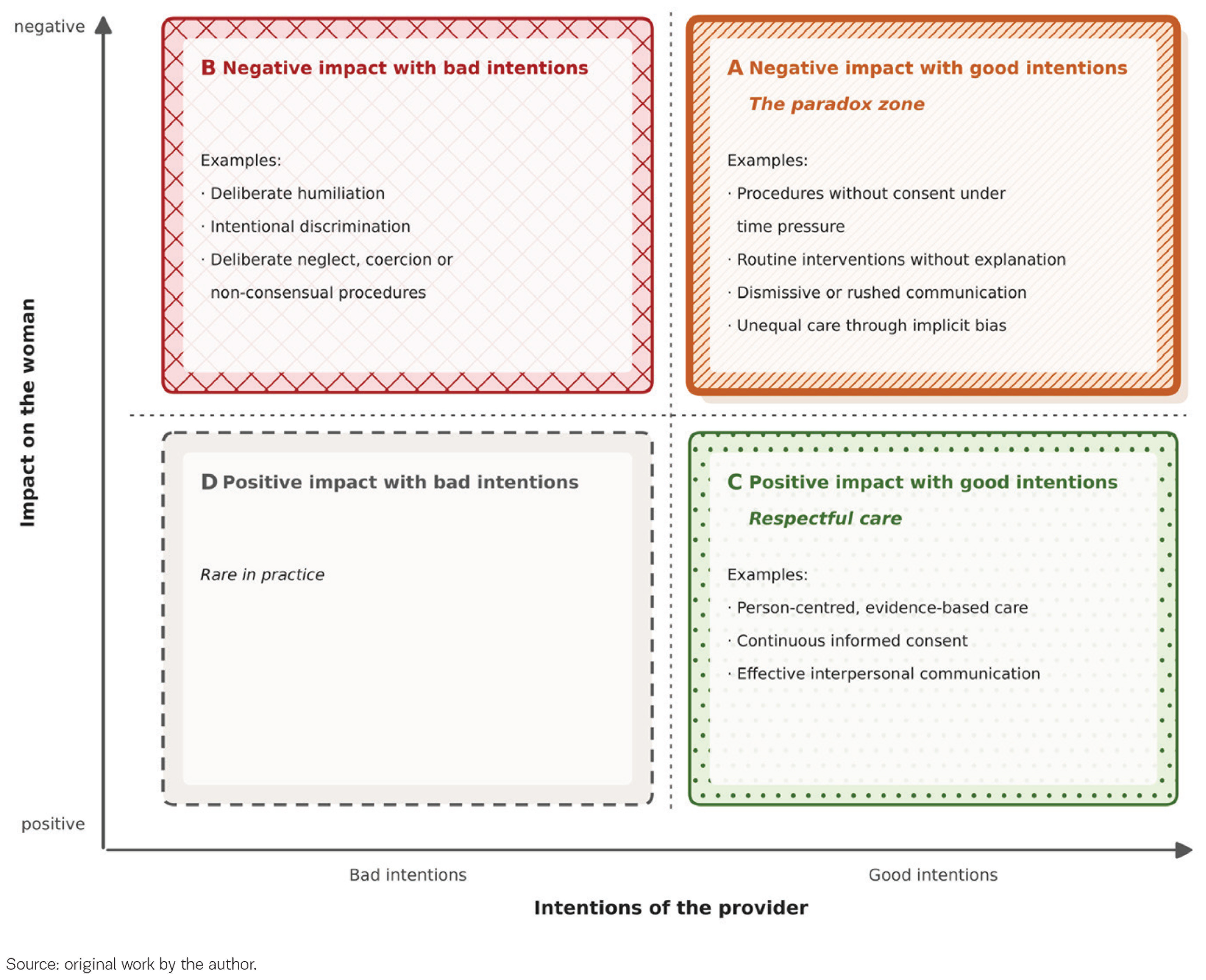
The figure presents the impact-intention paradox as a conceptual framework. The vertical axis represents the impact of care on the woman, from positive to negative, where negative impact refers to the harm she perceives. The horizontal axis represents the intentions of the provider, from bad to good, where bad intentions refer to any intention to cause harm and good intentions to the absence of such intention. Dotted lines divide the framework into four quadrants: (A) negative impact with good intentions, the paradox zone, in which the woman experiences harm that the provider did not intend; (B) negative impact with bad intentions, in which harm is both intended and experienced; (C) positive impact with good intentions, which corresponds to respectful care; and (D) positive impact with bad intentions, in which harm is intended but not experienced, a situation that is rare in practice. The framework aims to visualize that disrespect and abuse often fall into the paradox zone of negative impact despite good intentions3,10. Examples are illustrative.
Importantly, the paradox cuts both ways, which calls for distinguishing individual from system accountability. Healthcare providers should not be held personally accountable for structural failures they cannot control20, although they remain accountable for how they respond to it. In my view, an open culture that names problematic patterns without personalizing blame serves women and healthcare providers better than either impunity or criminalisation10,20. This points to a practical reorientation. Complaint systems rarely achieve both individual case resolution and system-wide learning from aggregated complaints21. What is needed is a shift in professional culture and in how complaints are received: at both the individual and the system level, good intentions are no excuse for inaction, and the primary question should always be: ‘What was the experience, and what in the system produced it?’.
The impact-intention paradox describes a tension that healthcare providers, researchers, and policymakers all face, everywhere maternity care is delivered. Separating the assessment of impact from the attribution of intent, while holding that both matter, is a precondition for taking women’s experiences of childbirth care seriously, whatever country or income setting they occur in. This means recognizing that a healthcare worker, or the broader health system, can cause lasting harm without intending to. Recognizing this can be the beginning of honest reflection, systemic learning and change.