
RESEARCH PAPER
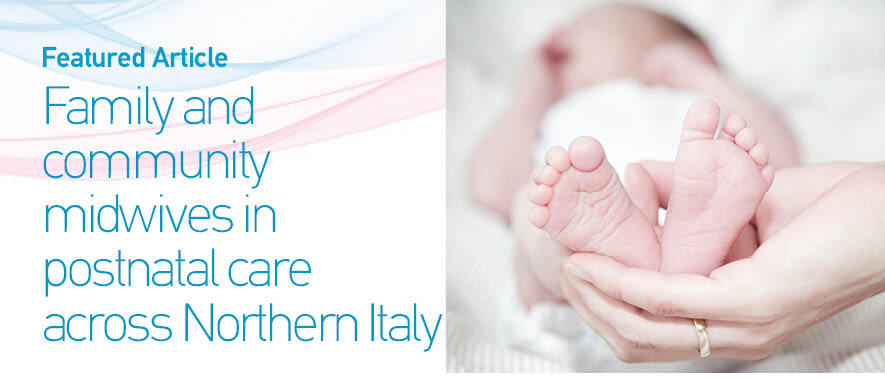
The experience of Family and Community Midwives in postnatal care: A qualitative study in Italy
1
School of Medicine and
Surgery, University of Milano-
Bicocca, Monza, Italy
2
Department of Biomedical
Science, Humanitas University in
Milan, Milan, Italy
Submission date: 2025-02-06
Final revision date: 2025-04-04
Acceptance date: 2025-04-22
Publication date: 2025-05-26
Corresponding author
Cristina Lumia
School of Medicine and Surgery, University of Milano-Bicocca, Via Cadore n. 48, 20900 Monza, Italy
School of Medicine and Surgery, University of Milano-Bicocca, Via Cadore n. 48, 20900 Monza, Italy
Eur J Midwifery 2025;9(May):24

KEYWORDS
TOPICS
ABSTRACT
Introduction:
Historically, national and international policies have focused more on care during pregnancy and childbirth rather than on the postnatal period. To solve the necessity of ensuring continuity of care after childbirth, the role of Family and Community Midwives (FaCM) was established permanently. The aim of the study is to explore the experiences and perspectives of the FaCM working in the Lombardy region of Northern Italy.
Methods:
The method used in this qualitative study design is a descriptive phenomenological approach. The data collection was conducted through semi-structured interviews with FaCM who voluntarily indicated their willingness to participate in the study from January to March 2024. The interviews followed a topic guide based on available literature.
Results:
Fifteen FaCM participated in the interviews. Two main themes emerged: 1) The contribution of a committed midwife in the community setting; and 2) The relationship between midwives, women, and other professionals. The contribution of a committed midwife in the community setting emphasized the novel role played by FaCM and their experience staying in connection with women after childbirth. Furthermore, midwives are the designated professionals responsible for ensuring continuity of care during the postnatal period. Relationships between midwives, women, and other professionals involved the challenge of collaborating within a team instead of working alone in a local service.
Conclusions:
The findings reflect the experience of FaCM in an entirely new postnatal community care setting. Enhancing the contribution of midwives alongside mothers and other professionals positively impacts the health of mothers and infants throughout the whole postnatal experience.
Historically, national and international policies have focused more on care during pregnancy and childbirth rather than on the postnatal period. To solve the necessity of ensuring continuity of care after childbirth, the role of Family and Community Midwives (FaCM) was established permanently. The aim of the study is to explore the experiences and perspectives of the FaCM working in the Lombardy region of Northern Italy.
Methods:
The method used in this qualitative study design is a descriptive phenomenological approach. The data collection was conducted through semi-structured interviews with FaCM who voluntarily indicated their willingness to participate in the study from January to March 2024. The interviews followed a topic guide based on available literature.
Results:
Fifteen FaCM participated in the interviews. Two main themes emerged: 1) The contribution of a committed midwife in the community setting; and 2) The relationship between midwives, women, and other professionals. The contribution of a committed midwife in the community setting emphasized the novel role played by FaCM and their experience staying in connection with women after childbirth. Furthermore, midwives are the designated professionals responsible for ensuring continuity of care during the postnatal period. Relationships between midwives, women, and other professionals involved the challenge of collaborating within a team instead of working alone in a local service.
Conclusions:
The findings reflect the experience of FaCM in an entirely new postnatal community care setting. Enhancing the contribution of midwives alongside mothers and other professionals positively impacts the health of mothers and infants throughout the whole postnatal experience.
CONFLICTS OF INTEREST
The authors have completed and submitted the ICMJE Form
for disclosure of Potential Conflicts of Interest and none was
reported.
FUNDING
There was no source of funding for this research.
ETHICAL APPROVAL AND INFORMED CONSENT
Ethical approval was obtained from the Ethics Committee of the
Milano-Bicocca University (Approval number: 0040874/22; Date
12 December 2022).
DATA AVAILABILITY
The data supporting this research are available from the authors
on reasonable request.
PROVENANCE AND PEER REVIEW
Not commissioned; externally peer reviewed.
REFERENCES (36)
1.
World Health Organization. WHO Technical Consultation on Postpartum and Postnatal Care. WHO; 2010. Accessed April 3, 2025. https://www.ncbi.nlm.nih.gov/b...
2.
Johansson K, Lilja M, Park M, Josephsson S. Balancing the good – a critical discourse analysis of home modification services. Sociol Health Illn. 2010;32(4):563-582. doi:10.1111/j.1467-9566.2009.01232.x
3.
Sacks E, Langlois ÉV. Postnatal care: increasing coverage, equity, and quality. Lancet Glob Health. 2016;4(7):e442-e443. doi:10.1016/S2214-109X(16)30092-4
4.
Zadoroznyj M. Postnatal care in the community: report of an evaluation of birthing women's assessments of a postnatal home-care programme. Health Soc Care Community. 2007;15(1):35-44. doi:10.1111/j.1365-2524.2006.00664.x
5.
WHO recommendations on maternal and newborn care for a positive postnatal experience. WHO. March 30, 2022. Accessed April 3, 2025. https://www.who.int/publicatio...
6.
Dahlberg U, Haugan G, Aune I. Women's experiences of home visits by midwives in the early postnatal period. Midwifery. 2016;39:57-62. doi:10.1016/j.midw.2016.05.003
7.
Online i risultati dell’Indagine nazionale sui consultori familiari 2018-2019. Istituto Superiore di Sanità. July 13, 2022. Updated July 13, 2022. Accessed April 3, 2025. https://www.iss.it/primo-piano...
8.
Postnatal care. National Institute for Health and Care Excellence. April 20, 2021. Updated April 20, 2021. Accessed April 3, 2025. https://www.nice.org.uk/guidan...
9.
Malouf R, Henderson J, Alderdice F. Expectations and experiences of hospital postnatal care in the UK: a systematic review of quantitative and qualitative studies. BMJ Open. 2019;9(7):e022212. doi:10.1136/bmjopen-2018-022212
10.
Goodwin L, Taylor B, Kokab F, Kenyon S. Postnatal care in the context of decreasing length of stay in hospital after birth: The perspectives of community midwives. Midwifery. 2018;60:36-40. doi:10.1016/j.midw.2018.02.006
11.
ten Hoope-Bender P, Lopes ST, Nove A, et al. Midwifery 2030: a woman's pathway to health. What does this mean? Midwifery. 2016;32:1-6. doi:10.1016/j.midw.2015.10.014
12.
Giorgi A. Sketch of a psychological phenomenological method. In: Giorgi A, ed. Phenomenology and psychological research. Duquesne University Press; 1985:8-22.
13.
Giorgi A. The descriptive phenomenological method in psychology: a modified Husserlian approach. Duquesne University Press; 2009.
14.
Sinfield G, Goldspink S, Wilson C. Waiting in the Wings: The Enactment of a Descriptive Phenomenology Study. Int J Qual Methods. 2023;22:1-11. doi:10.1177/16094069231207012
15.
Bengtsson M. How to plan and perform a qualitative study using content analysis. NursingPlus Open. 2016;2:8-14. doi:10.1016/j.npls.2016.01.001
16.
Wouters E, Van Damme W, van Rensburg D, Masquillier C, Meulemans H. Impact of community-based support services on antiretroviral treatment programme delivery and outcomes in resource-limited countries: a synthetic review. BMC Health Serv Res. 2012;12:194. doi:10.1186/1472-6963-12-194
17.
Lewin S, Munabi-Babigumira S, Glenton C, et al. Lay health workers in primary and community health care for maternal and child health and the management of infectious diseases. Cochrane Database Syst Rev. 2010;2010(3):CD004015. doi:10.1002/14651858.CD004015.pub3
18.
Gray M, Malott A, Davis BM, Sandor C. A scoping review of how new midwifery practitioners transition to practice in Australia, New Zealand, Canada, United Kingdom and The Netherlands. Midwifery. 2016;42:74-79. doi:10.1016/j.midw.2016.09.018
19.
Colaceci S, Cicero RV, Giorgini G, et al. Italian midwives' education needs analysis on essential competencies for childbirth care: A cross-sectional study. Midwifery. 2021;103:103147. doi:10.1016/j.midw.2021.103147
20.
Harvey C, Hegney D, Sobolewska A, et al. Developing a community-based nursing and midwifery career pathway - A narrative systematic review. PLoS One. 2019;14(3):e0211160. doi:10.1371/journal.pone.0211160
21.
Crowther S, MacIver E, Lau A. Policy, evidence and practice for post-birth care plans: a scoping review. BMC Pregnancy Childbirth. 2019;19(1):137. doi:10.1186/s12884-019-2274-y
22.
Zbiri S, Rozenberg P, Milcent C. Access-to-care: evidence from home-based postnatal coordinated care after hospital discharge. BMC Health Serv Res. 2021;21(1):1137. doi:10.1186/s12913-021-07151-3
23.
Johansson M, Thies-Lagergren L. Women's experience of the decision-making process for home-based postnatal midwifery care when discharged early from hospital: A Swedish interview study. Eur J Midwifery. 2022;6(September):1-7. doi:10.18332/ejm/152547
24.
Eikemo R, Vikström A, Nyman V, Jonas W, Barimani M. Support during the postnatal period: Evaluating new mothers' and midwives' experiences of a new, coordinated postnatal care model in a midwifery clinic in Sweden. Scand J Caring Sci. 2023;37(1):260-270. doi:10.1111/scs.13103
26.
Davis DL, Walker K. Case-loading midwifery in New Zealand: making space for childbirth. Midwifery. 2010;26(6):603-608. doi:10.1016/j.midw.2009.01.004
27.
Renfrew MJ, McFadden A, Bastos MH, et al. Midwifery and quality care: findings from a new evidence-informed framework for maternal and newborn care. Lancet. 2014;384(9948):1129-1145. doi:10.1016/S0140-6736(14)60789-3
28.
van Wijngaarden M, Blonk H, Simmelink R, et al. Working in smaller teams in community midwifery practices to foster continuity of carer: Midwives' experiences - A qualitative study in the Netherlands. Women Birth. 2024;37(6):101663. doi:10.1016/j.wombi.2024.101663
29.
Everly MC. Facilitators and barriers of independent decisions by midwives during labor and birth. J Midwifery Womens Health. 2012;57(1):49-54. doi:10.1111/j.1542-2011.2011.00088.x
30.
Watters C, Reedy G, Ross A, Morgan NJ, Handslip R, Jaye P. Does interprofessional simulation increase self-efficacy: a comparative study. BMJ Open. 2015;5(1):e005472. doi:10.1136/bmjopen-2014-005472
31.
Najmi LA, Mohammad-Alizadeh-Charandabi S, Abbasalizadeh F, Poormehr HS, Pashazade F, Mirghafourvand M. A clinical guideline for the Iranian women and newborns in the postpartum period. BMC Health Serv Res. 2024;24(1):563. doi:10.1186/s12913-024-11026-8
32.
Adekojo O, Revell KR, Preece H, Morris S, Coleman MA, Holt RI. Low uptake of postpartum screening for Type 2 diabetes in women after a diagnosis of gestational diabetes. Diabet Med. 2016;33(11):1599-1601. doi:10.1111/dme.13084
33.
Douglas PS, Hiscock H. The unsettled baby: crying out for an integrated, multidisciplinary primary care approach. Med J Aust. 2010;193(9):533-536. doi:10.5694/j.1326-5377.2010.tb04039.x
34.
Boerleider AW, Francke AL, van de Reep M, Manniën J, Wiegers TA, Devillé WL. "Being flexible and creative": a qualitative study on maternity care assistants' experiences with non-Western immigrant women. PLoS One. 2014;9(3):e91843. doi:10.1371/journal.pone.0091843
35.
Wiseman O, Holland S. Is caseloading sustainable? The 25-year history of caseloading at King’s College Hospital. Pract Midwife. 2018;21(8):20-25. doi:10.55975/shxi6614
36.
van Minde MRC, Remmerswaal M, Raat H, Steegers EAP, de Kroon MLA. Innovative postnatal risk assessment in preventive child health Care: A study protocol. J Adv Nurs. 2020;76(12):3654-3661. doi:10.1111/jan.14547
CITATIONS (3):
1.
Impact of Community Midwifery Care (CMC) on maternal and neonatal wellbeing in postnatal period: a qualitative study
Cristina Lumia, Matilde Flossi, Antonella Nespoli
BMC Pregnancy and Childbirth
Cristina Lumia, Matilde Flossi, Antonella Nespoli
BMC Pregnancy and Childbirth
2.
Multidisciplinary Team Perceptions on Preparing Newborns for Discharge From a Rooming‐in Unit: A Qualitative Study
Thaís Emanuele da Conceição, Adriana Duarte Rocha, Cristina Lumia, Simona Fumagalli, Antonella Nespoli, Maria Helena do Nascimento Souza
Health Science Reports
Thaís Emanuele da Conceição, Adriana Duarte Rocha, Cristina Lumia, Simona Fumagalli, Antonella Nespoli, Maria Helena do Nascimento Souza
Health Science Reports
3.
Midwifery Continuity of Care Supports Shared Decision-Making in Pregnancy With Mild Uterine Prolapse: A Qualitative Case Report
Cristina Lumia, Gaia Rosa, Adele Zurlo, Marzia Serafini
Nursing for Women's Health
Cristina Lumia, Gaia Rosa, Adele Zurlo, Marzia Serafini
Nursing for Women's Health
Share
RELATED ARTICLE
| eISSN: | 2585-2906 |

We process personal data collected when visiting the website. The function of obtaining information about users and their behavior is carried out by voluntarily entered information in forms and saving cookies in end devices. Data, including cookies, are used to provide services, improve the user experience and to analyze the traffic in accordance with the Privacy policy. Data are also collected and processed by Google Analytics tool (more).
You can change cookies settings in your browser. Restricted use of cookies in the browser configuration may affect some functionalities of the website.
You can change cookies settings in your browser. Restricted use of cookies in the browser configuration may affect some functionalities of the website.
