


INTRODUCTION
The midwifery profession is key to ensuring maternal and infant health, both in Switzerland and internationally. Numerous studies have highlighted that midwife-led and continuity-of-care models are associated with fewer medical interventions (e.g. cesarean section, episiotomy), enhanced maternal and neonatal outcomes, higher family satisfaction, and cost-effectiveness1-4. Despite these proven benefits, ensuring consistent and safe midwife-led care – particularly in out-of-hospital settings – requires clear and evidence-based professional frameworks.
In Switzerland, the responsibilities of midwives in pregnancy and birth care vary significantly depending on the chosen place of birth5. Pregnant women can choose to give birth in a hospital, a birth center, or at home, and all of these options are covered by the national health insurance system6. While hospital births are strictly governed by institutional protocols, birth centers are also commonly considered recognized healthcare facilities7. In 2023, 1.2% of births in Switzerland took place in the family home8.
Although the right to a home birth is enshrined in Swiss law and the associated costs are reimbursed by the national health insurance system9, such births are not currently supported by any official national recommendations. The midwives who provide this care practice independently and in diverse professional contexts, making it difficult to harmonize practices. This lack of a shared reference framework poses challenges in terms of safety, quality of care, and professional recognition. The SFM therefore took action to strengthen the quality of care in the field of home birth10.
The SFM is the sole national professional association representing midwives in Switzerland11. As of 2024, it brings together over 3500 members across the different linguistic regions of the country, including 2684 in the German-speaking part, 751 in the French-speaking part, and 88 in the Italian-speaking part12. The Federation plays a key role in promoting high-quality midwifery care13,14, supporting continuing professional education15, and influencing health policies related to maternal and newborn care16,17. The SFM also oversees quality monitoring and maintains statistical records on midwifery practice and birth settings throughout the country8.
In response to the diversity of individual practices and the absence of shared selection criteria to determine which situations are appropriate for home birth, the aim of this project is to develop a national list of ineligibility criteria for home birth, based on scientific evidence.
By focusing on ineligibility criteria, we can avoid unnecessarily restricting access to home birth for women who are otherwise good candidates for it, promoting a more individualized approach to care. To ensure scientific rigor in the process of developing such criteria, the SFM appointed a working group composed of academic and clinical midwifery experts. This article outlines the development process, methodological framework, and rationale behind the creation of these national guidelines.
COMMENTARY
The development of Swiss national guidelines for selecting pregnancies for which home birth would be suitable was conducted between July 2024 and May 2025. The process unfolded in four main phases.
Phase 1: Literature review
The initial phase consisted of a systematic review of existing international guidelines on eligibility for home birth, conducted by AB, PZ and AS, between July and September 2024. The following databases and repositories were searched, combining subject headings and free-text terms to identify relevant guidelines: Guideline Central, Guideline International Network, la Haute Autorité de Santé, Joanna Briggs Institute EBP Ovid, and Trip medical database (Supplementary file). Keywords consisted of ‘home birth’ and ‘guideline’ and their synonyms. Manual searches were conducted for other professional societies and grey literature, including position papers and consensus statements.
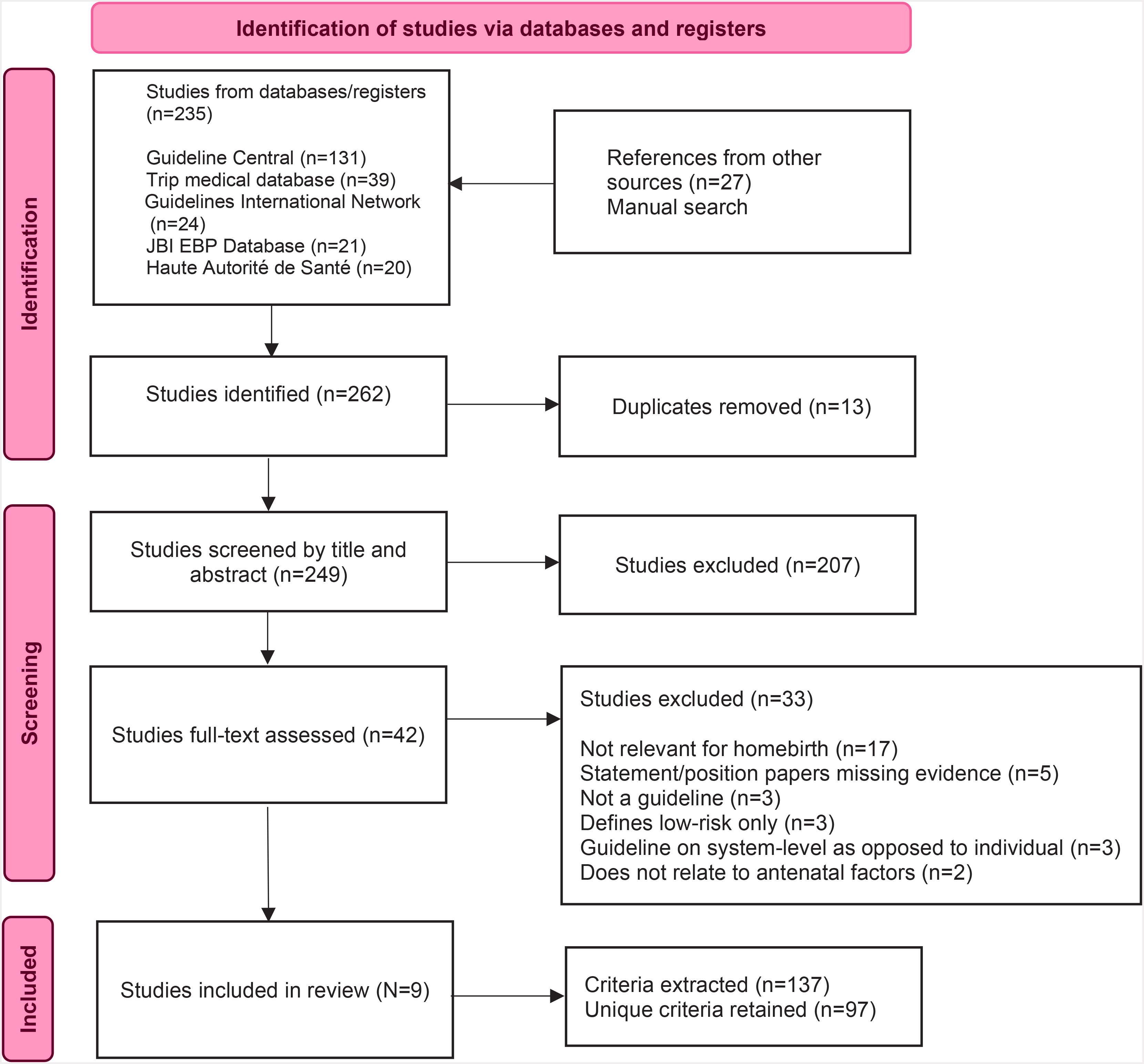
A total of 262 references were imported for screening. After duplicates were removed, 249 records were screened based on their titles and abstracts. Two reviewers independently assessed each record, and, in cases of disagreement, discussions were held amongst the three reviewers until a consensus was reached. Of these 249 articles, 42 met the following predefined criteria. These criteria required that publications must explicitly focus on out-of-hospital or home birth, represented a set of international guidelines, were published in English, French, Italian, German, or Dutch, and provided evidence supporting their methodological validity.
After that, the full text of 42 sets of guidelines was assessed for relevance to our project. Of these, 33 were excluded, primarily because they were not relevant to home birth, lacked supporting evidence, or addressed system-level rather than individual eligibility criteria. During the full-text assessment, the evaluation method was the same as for the screening phase, except that four senior clinical midwives with expertise in home birth joined the team of reviewers. The full text of each set of guidelines was evaluated by one senior clinical midwife and one academic midwife.
Ultimately, nine sets of guidelines18-26 met the inclusion criteria. From these, the team extracted 137 potential ineligibility criteria for home birth. After merging duplicates, a list of 97 unique criteria was established (Figure 1). The final list was subsequently translated by AB and PZ into French and German to be used in the next phase of the process.
Phase 2: Expert classification
The second phase of the project was performed between October and December 2024, which involved the systematic classification of the 97 ineligibility criteria identified in the literature review. To ensure a broad and practice-oriented perspective, additional experienced clinical midwives were recruited through the SFM to participate in three workshops. To be eligible to participate, they had to have more than 5 years’ experience as midwives performing home births, and at least 40% of their clinical practice had to involve home birth care. The second-phase process was inspired by the Delphi method, a structured consensusbuilding technique in which experts independently assess predefined items across iterative rounds and receive anonymized feedback between rounds, allowing controlled interaction and progressive movement toward consensus27.
Online questionnaire
Prior to the in-person workshops, the 30 invited clinical midwives completed an online questionnaire designed to accelerate the process and ensure participants were familiar with the proposed criteria. They were asked to classify each criterion as either absolute (care in an obstetric unit would be expected) or relative (requiring further individualized assessment).
Regional workshops
Three regional workshops were then organized to facilitate in-depth discussion and collective decision-making about the home birth-related criteria, in Lausanne (6 participants), Bern (12 participants), and Winterthur (10 participants). During these workshops, each criterion was discussed and voted upon. When a criterion was considered relative, participants were asked to specify the type of assessment required to ensure safe decision-making.
Consensus building
At the conclusion of the workshops, most of the 97 criteria had been categorized by a majority of the participants as either absolute or relative. For criteria lacking a clear majority, the eight authors reviewed the results and sought consensus through discussion and by consulting evidence. While certain criteria had to be adapted to the Swiss context, none of the 97 ineligibility criteria identified in the literature was excluded.
This structured process ensured that the classification of criteria combined scientific evidence with the practical expertise of midwives specialized in home birth care, providing a balanced set of guidelines that is appropriate for the Swiss context.
Phase 3: National consultation
The third phase, conducted in March 2025, involved a nationwide ballot of all members of the SFM. An online survey was distributed in French and German, along with a message explaining the rationale and importance of establishing unified national criteria for home birth. Respondents were invited to review the proposed list of criteria and were encouraged to indicate any disagreement, supported by relevant scientific evidence. By April 2025, 433 responses had been received.
Phase 4: Finalization and structure of the guidelines
In the final phase, the working group reviewed the feedback received during the national ballot and finalized the guidelines. The comments submitted by SFM members mainly led to minor clarifications of wording, improved consistency across categories, and the addition of brief contextual explanations for a few criteria. No new evidencebased arguments emerged that warranted adding or removing criteria, but the consultation helped refine the formulation of the final guideline and ensured that the list reflected both professional consensus and practical usability.
Finally, the 97 criteria were classified into four categories following the National Institute for Health and Care Excellence guidelines, which served as the main reference framework for this study. The first category consists of medical conditions indicating increased risk and suggesting that the birth should occur in a hospital environment (Table 1), while the second comprises other factors indicating increased risk and suggesting that the birth should occur in a hospital environment (Table 2). The third category includes medical conditions indicating that individual assessment is needed when deciding on the place of birth (Table 3), and the fourth encompasses additional factors that indicate the need for individual assessment when deciding on the place of birth (Table 4). The relevant references are given in square brackets within each Table.
Table 1
Medical conditions indicating increased risk and suggesting planned birth in a hospital environment
| Area of disease | Medical condition |
|---|---|
| Cardiovascular | • Hypertensive disorder – essential or gestational hypertension [18, 22] |
| Hematological | • Anemia – hemoglobin less than 85 g/L at onset of labor [19] • Immune thrombocytopenia purpura or other platelet disorder or platelet count below 100×109/L [19] • Von Willebrand's disease [19] |
| Endocrine | • Insulin dependent diabetes [18–20, 22] |
| Infective | • Hepatitis B or C – with abnormal liver function tests [19] • Tuberculosis under treatment [18, 19] |
| Gastrointestinal | • Liver disease associated with current abnormal liver function tests [19] |
| Psychiatric | • Severe mental health disorder requiring multiple psychotropic medications* [21] • Psychiatric disorder requiring current inpatient care [19] |
Table 2
Other factors indicating increased risk and suggesting planned birth in a hospital environment
| Factor | Additional information |
|---|---|
| Previous complications | • Previous uterine rupture [19] |
| Current pregnancy | • Current placental abruption [18, 19] • Current pre-eclampsia [18, 19] • Current preterm labor (active labor before 37+0 weeks gestation) [18, 19, 22, 24] • Multiple birth [18, 19, 22, 24] • Breech or transverse presentation [18, 19, 23, 24] • Oligohydramnion with additional complicating factors [18] • Placenta previa [18, 19] • Alcohol dependence requiring assessment or treatment [18, 19] • Intrauterine infection [22] • Intrauterine growth restriction (IUGR) <5th percentile [18, 19, 23] * • Evidence of congenital fetal anomalies requiring immediate assessment and/or management by a neonatal specialist [18, 19, 22] • Pharmacological induction of labor [18, 19] • Rhesus isoimmunization [18] |
* Deutsche Gesellschaft für Gynäkologie und Geburtshilfe & Deutsche Gesellschaft für Hebammenwissenschaft guideline (2020) mentions IUGR as risk but does not recommend a cutoff percentile. In the National Institute for Health and Care Excellence guideline (2023), the recommended cut off is the 3rd percentile.
Table 3
Medical conditions indicating individual assessment is needed when planning place of birth
Table 4
Other factors which indicate individual assessment
| Factor | Additional information | Recommended assessment |
|---|---|---|
| Previous complications | • Stillbirth or neonatal death with a known, non-recurrent cause [19] • Prior cesarean section [18, 19, 24] • Macrosomia – history of previous baby >4500 g [19] • Previous baby with jaundice requiring exchange transfusion [19] | Assessment by the midwife |
| • Previous placental abruption – with good outcome [19] • Pre-eclampsia developing at term in last pregnancy [19] • Previous primary postpartum hemorrhage requiring additional procedures [18, 19] • Previous retained placenta needing manual removal in theatre [19] • Previous shoulder dystocia [18, 19] • Unexplained stillbirth and/or neonatal death, or previous death related to intrapartum difficulty [18, 19] | Assessment in collaboration with a senior home birth midwife or quality circle | |
| • Extensive vaginal, cervical or 4th degree perineal birth trauma in previous birth [19]a • Previous placental abruption – with adverse outcome [19] • Eclampsia [19] • Pre-eclampsia/HELLP syndrome requiring preterm birth [19, 22] | Assessment in collaboration with an obstetrician-gynecologist | |
| • Previous baby with encephalopathy [19] | Assessment in collaboration with a specialist doctor | |
| Current pregnancy | • Age >40 years at beginning of pregnancy [19] • Group b streptococcus positive where intrapartum intravenous antibiotics are recommended [19] | Assessment by the midwife |
| • Anemia – hemoglobin 85 to 105 g/L at onset of labor [19] • Antepartum bleeding of unknown origin (single episode after 24 weeks of pregnancy) [19] • Grand multiparity – parity ≥5 [19, 25]b • Macrosomia – clinical or ultrasound suspicion [19, 20] • Post term more than 41+6 weeks [18, 24, 25] • Suspected small for gestational age (SGA), <3rd percentile [19, 22, 23]c • Recreational drug used [19] | Assessment in collaboration with a senior home birth midwife or quality circle | |
| • Body mass index ≥35 kg/m2 [19] • Recurrent antepartum hemorrhage [19] • Blood pressure ≥140 mmHG systolic or • ≥90 mmHG diastolic on two occasions [19] • Intrauterine death [19] • Intrauterine growth restriction (IUGR) ≥5th percentile [18, 23]e • Ultrasound diagnosis of oligo- or poly-hydramnion [18, 19, 23] | Assessment in collaboration with an obstetrician-gynecologist | |
| • Abnormal fetal heart rate [19, 22] • Fetal abnormality [19, 22] | Assessment in collaboration with an obstetrician-gynecologist and pediatrician | |
| • Substance misuse during pregnancy [18, 19, 22]f • Medical conditions that have required acute medical supervision during pregnancy [18] | Assessment in collaboration with a specialist doctor |
b National Institute for Health and Care Excellence Guideline (2023) suggest grand multiparity of ≥4 to be at increased risk.
c Deutsche Gesellschaft für Gynäkologie und Geburtshilfe & Deutsche Gesellschaft für Hebammenwissenschaft guideline (2020) mentions SGA as risk but does not recommend a cutoff percentile.
d The term ‘recreational drug use’ refers to any type of consumption of legal or illegal psychoactive substances which occurs occasionally or regularly for recreational purposes. The term is therefore used in contrast to dependent drug use or substance misuse.
The recommendations for evaluating relative criteria (Tables 3 and Table 4) involved one of the following: assessment by the primary midwife; joint assessment with an experienced home birth midwife or within a quality circle (method of quality improvement in primary care28); or assessment in collaboration with a medical specialist.
In addition to refining the list of criteria, the team also drafted a preamble and a concluding section to support the appropriate use of the guidelines in clinical practice. The preamble outlines the rationale and scope of the document, emphasizing that planned home birth can be a safe and valid option when supported by adequate selection criteria and professional midwifery care. It should also be acknowledged that situations may arise where care is provided outside the defined guidance, particularly when this results from the woman’s informed decision, a complex issue that goes beyond the scope of this article.
The finalized guidelines, published in May 2025, are available in both French and German29 and are intended to serve as a national reference for the safe and consistent planning of home births in Switzerland.
Strengths and limitations
This initiative represents a significant step forward in supporting the safe and harmonized practice of home birth in Switzerland. It resulted in the development of a national set of evidence-based guidelines specifically designed for planned home births. However, several limitations and considerations must be acknowledged.
One key issue concerns how out-of-hospital birth is defined. In the international literature, distinctions between midwifery-led units, birthing centers, and home birth are not always clearly defined. Although the set of Swiss guidelines established here was developed specifically for planned home births, some criteria may overlap with those relevant to broader out-of-hospital settings. This should be taken into consideration when interpreting and applying the recommendations in clinical practice.
Another important aspect is the dynamic nature of clinical care. As practices evolve and new evidence emerges, the guidelines must be adapted. To achieve this, the current list of ineligibility criteria will be regularly reviewed and updated to ensure it continues to reflect the best available evidence and actual clinical conditions in Switzerland.
Implications
The success of these guidelines will ultimately depend on their effective implementation. To support this, the SFM, together with its cantonal sections, has proactively engaged with cantonal health departments to promote awareness and encourage institutional support. Dissemination efforts are also being directed towards midwives, healthcare providers, and educators involved in perinatal care. Finally, to ensure wider accessibility and usability across Switzerland, a translation into Italian is currently in progress.
CONCLUSION
This article describes the structured, multi-phase process through which the SFM developed the first national guidelines defining ineligibility criteria for planned home birth. Grounded in international literature and refined through expert clinical input and national consultation, the final list of criteria provides consistent, evidence-informed guidelines to support safe and autonomous decision-making in midwifery-led care. The implementation of these guidelines, accompanied by periodic updates and broad dissemination, should contribute to strengthening the quality and coherence of home birth practices across Switzerland.

